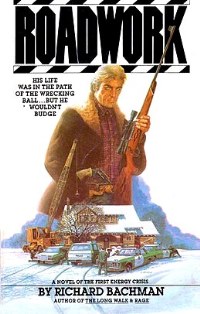
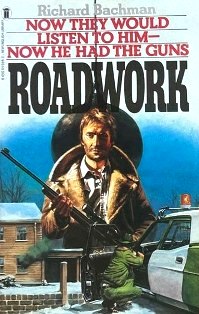
First published back in March of 1981, Stephen King’s novel ‘Roadwork’ was originally published under the pseudonym Richard Bachman, forming the third novel of seven to be published under the Bachman name.
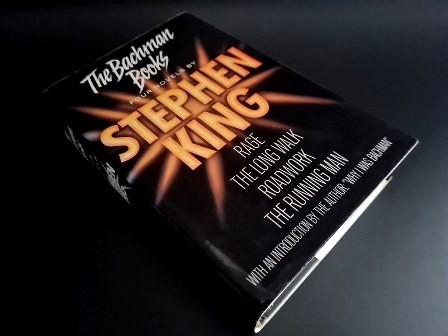
The novel was later collected within King’s ‘The Bachman Books’ (1985) omnibus, which contained the first four novels which were published under this pseudonym.
DLS Synopsis:
DLS Review:

The council’s plan to build the 784 highway extension had been given the all clear. The new eight-lane highway would extend from the town, reaching outwards for many miles, straight through a huge stretch of suburban residential estate. A once quiet suburbs where Barton Dawes and his wife currently lived.
Despite the above-market-price offering the couple had been offered for their property, Bart wasn’t happy. In fact, knowing his house would be levelled to make way for a highway was beyond devastating. The council had told him that he had a year to find a new house. What he faced was non-negotiable. It was a fact he simply had to accept.
However, to Bart, this was more than just an upheaval of their life. Mary and he had half a lifetime of history within their home. They’d raised their son within those four walls. Looked after him and loved him for the short time they’d had, until fate had taken the young boy away from them.
Bart had worked shift after shift at the Blue Ribbon Laundry facility, moving up the ranks until he was in a position of authority. The money he’d brought in from years of hard work had been ploughed into making a life and future for Mary and him. A future which was now on the verge of being snatched away, without so much as an apology.
Bart felt lost. That despite his best efforts, he’d lost control of his own life. There was nothing right or fair about what he and his wife now faced. Robbed of his future. Unfairly cast aside by a thoughtless, faceless government.
Now time was running out for him. As Christmas of 1973 drew ever closer, so did the deadline for this forced eviction for their home. Bart not only had his own residence to sort relocation, but also that of the laundry facility which stood along the route of the proposed 784.
Bart had no choice now but to act. There was now no further time to see how this might otherwise play out. Now was the time to take action for his future, that of his wife, and also for his colleagues.
However, the actions Bart would take were not what those expected of him. Bart felt hurt. Felt shunned. But most of all, Bart felt angry. Seething with hatred for the 784 extension, along with all those faceless bullies behind its construction. He was now at the point of breaking. A cliff edge where his next moves would shape his entire future. No turning back. This was it.
Bart was angry. Bart had become dangerous and unpredictable. And he wasn’t going to take this forced roadwork lightly…
It’s fair to say there’s a seething social commentary and escalating anger within these early Bachman novels. A sort of real-world grittiness that feels both raw and worryingly close to the bone to that of our own existence and society.
Like with the earlier Bachman novel – ‘Rage’ (1977) – this tale deals with a character who’s pushed to their breaking point and then reacts. It’s a very poignant premise, with a US perspective on the realities of modern-day issues (although set in the early 70s).
Essentially, it pretty much forms the blueprint to the 1993 film ‘Falling Down’ with the barebones essence of the plot. However, here there’s more of a directional focus to the anger exhibited by our lead character, the morally ambiguous anti-hero Bart. That rage, that unsurpassable, unquenchable, simmering anger is focused on the 784 highway extension and everything the roadwork represents.
Let’s be honest, at some point in all our lives we’ve felt there’s been some injustice against us. A forced situation that we want to make a stand against. Sometimes, that stand might lead you to escalating things to the point by which you’re cutting off your nose to spite your face (proverbially speaking).
Magnify that simmering anger (and the subsequent self-destructive retribution) to catastrophic levels, and you have the beating, burning heart of this novel. A tale wrapped up in a feeling of injustice and the anger that stemmed from this. A bitter novel, that edges closer and closer to a seemingly inevitable precipice.
If you’ve already read ‘Rage’ (1977), then you’ll probably have a good idea of the gritty and downtrodden temperament embedded within this piece. It feels almost political in its motivation. A hard criticism on how US life has turned its cheek on its own. At the mere flick of a switch, there’s a loss of hope, happiness and justice.
Of course, this all amounts to an incredibly character driven story – with Bart at the focal point of the whole thing. With this, King absolutely delivers what’s needed for the story to succeed. In Bart we have an example of a real life which we can perhaps all relate to in many ways. Struggles, ambitions, and the supposed reward for perseverance and hard work. But then to see this torn away without recourse, you yourself can’t help but side with Bart to some degree.
Then we have the self-destruction. Bart more than cutting off his nose but instead lopping off his entire head to smart his pissed off face. It gets you in the gut. It makes your heart cry out for the man. You can see it all unfolding, his world spiralling away as the inevitable day of demolition draws closer. A lost soul in an uncaring world with nowhere to go.
The novel is a down beaten, gritty read if ever there was one. Although in reality it’s not page after page of misery and gloom, the handful of peaks seem to make the troughs that much deeper. Seeing what Bart had, what he could have had, what could have been if the cards had just fallen a little different, it gets to you. The fragility of life. Or perhaps is it better put the fragility of modern life?
King originally didn’t care much for the novel but eventually came round to being satisfied with it. You can kind of get that. See why, understand there was a lost confusion in him at the time, which he wanted to represent in the novel, and through Bart. It works. It helps paint a picture.
If you’re a King fan, then this is in my opinion is essential reading. For a more casual reader, it offers a huge amount to draw you into the tale. Wonderful character development, an escalating tense read, a connection with the reader, and a powerful and memorable ending.
Of King’s work it’s probably one of the most overlooked and underrated, which if you ask this reviewer, is a crying shame.
The novel runs for a total of 274 pages.
© DLS Reviews