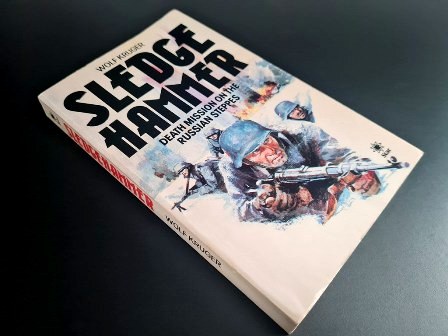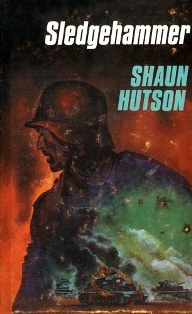
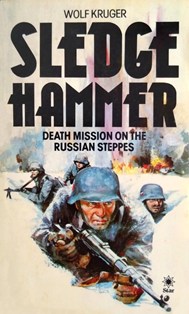
First published back in January of 1982, British author Shaun Hutson’s second novel was the pulp war story ‘Sledgehammer’ which formed the first book within the Sgt. Rolf Kessler series.
The novel was rereleased in October of 1983 under Hutson’s war story pseudonym – Wolf Kruger.
DLS Synopsis:
With Hitler’s army sweeping across the Eastern European Steppes, the German’s found the Russian Untermensch had started to flee from their frontmost ranks. As Sergeant Rolf Kessler and his men pushed onwards, the German soldiers constantly came across evidence of the Russians’ recent and swift departure. Wounded Russians. Food and supplies left discarded. Deserters left hanging from their necks.
The more signs of panicked, scrambling and hastily fleeing Russians they find along the way, the greater the German army’s confidence grows. That is, until they find themselves drawn into a trap. Seemingly from out of nowhere, the German’s come face-to face with a vast battalion of Russian tanks.
Suffering heavy losses, the German’s Colonel von Essen sets out an urgent mission for Kessler and his men. They’re to destroy the railhead at Yelsk, which should then cut off the Russian’s supply of armour and weaponry to the sector. This should then allow the Germans to continue pushing on with their campaign.
Unfortunately, the only way to reach the railhead is through the Pripet Marshes – a hundred and six miles of swamp and mud. Furthermore, a small guerrilla force is the only hope they have of achieving success.
Although Kessler commands a fierce respect among his men, even with his superiors, for this mission the twenty-five-year-old sergeant will not be leading his men alone. Instead, as an expert in guerilla warfare, Captain Jurgen Weiss will be in command of Kessler’s section.
Kessler is to select fifteen men from his section, and led by Weiss, they’re to travel through the marshes, destroy the railhead, and then make their way to Vasilevichi, where they’ll rendezvous with the main force. Their mission is of upmost importance. Should Kessler and his men fail, the Russians will have armour and supplies to continue holding the line against the German’s.
This mission cannot fail. This mission, code named Sledgehammer…
Following the release of his debut novel, Hutson returns here with a second war story which is also the first book in the ‘Sgt Rolf Kessler’ series, introducing us to the character of Sergeant Rolf Kessler.
First off, as with Hutson’s debut – ‘Blood And Honour’ (1981) – it’s perhaps important to note that the novel’s written from the perspective of soldiers within the German army during WWII. Although we all know who’s side we ultimately stand on, there are invariably more localised stories within the wider war which we don’t necessarily feel wrong with us following, from a more granular, more human perfective.
The whole story is essentially split into three distinct sections. The first largely sets the scene, introduces the characters, and takes us through the run up to the reveal of the mass Russian tank force lying in wait for the Germans arrival.
The next section sets down the main plot of the book before taking us through the Pripet Marshes, with all the problems the swampy environment entails. After Kessler’s men have endured the squelchy joy of the marshes, the final section sees the assault on the railhead at Yelsk and a last0minute slice of one-on-one vengeance-and-comeuppance played out.
That’s essentially the novel’s construction. It would also be fair to say the first half or so of the book feels a tad plodding. It delivers an incredibly down beaten atmosphere across the entirety of this initial third (or so) of the book, with death a decay constantly in the air. It’s all quite depressing.
This gritty and grim backdrop is then swapped for that of utter carnage when the troops head over the crest of a hill to find a shit tonne of Russian tanks waiting for them! Immediately, all hell quickly breaks loose, and the pulse of the book goes into overdrive.
The next section has the troops trekking across the swamp lands, which sees the novel taking on a more ‘horror’ inspired backdrop. Think of the Dead Marshes in Tolkien’s ‘The Two Towers’ (1954) only they’re not corpses of the drowned lurking within the murky depths of the swamp waters, but instead giant blood-thirsty leeches. Leeches the size of a man’s hand, with a razor-sharp bite to the buggers. Yeah, even in these early war story days, Hutson was already leaning towards some good old fashioned creature feature horror!
The final section of the book has all the drama and action-rich mayhem you’d expect and hope for. In fact, the assault on the railhead is nothing short of high-octane and adrenaline-pumping war story action, with chapter after chapter of fighting and explosions delivering the goods with gusto.
After this Hutson throws in a final plot twist involving a traitor in the midst, knocking off Kessler’s men one after the other each night. To be honest, it’s all a bit odd how it suddenly comes about. Sort of unnecessarily extending the novel, with an additional storyline that feels forced and really quite detached from the previous plot thread. It also holds zero surprises in the big reveal and with only a loose sketch of a character-driven plot behind it.
Nevertheless, as a whole the novel’s a good read. We have a rich cast of characters with the fifteen soldiers under Kessler. Soldiers we get to know individually to some degree. Indeed, Hutson makes sure to give each one of them a specific character trait which they can hang their respective hats upon.
We have the tubby Meyer who’s constantly thinking about food. Kirov, who’s a bigass Russian who’d switched sides and now fights with the German’s, carrying his Russian sabre around with him wherever he goes. We have the ex-SS man, Dierks, who’s mind is always on sex despite the bitter chill of the elements. Then there’s the military surgeon Stefel, and then the ex-school master Bier, with his intricate knowledge of weapons. Finally, we have Roth and Zimmerman, who are fiercely loyal to Kessler.
One constant within the novel is the feeling of oppressive gloom which Hutson has quite purposefully harvested to its full potential. The soldiers have a harsh and miserable existence, where every day is a challenge and the smallest of life’s pleasures becomes a big deal for them.
Set in Eastern Europe, you can imagine how the vodka and schnapps are passed around these men like water. In fact, they seem to have an endless supply of booze. The troops also seem to live off mouldy bread and little else. Well, the fighting soldiers anyway. The officers on the other hand have vast banquets, with roast lamb and all the trimmings, washed down with lashings of fine wine.
Oddly, Kessler doesn’t fully take front-and-centre stage in the novel. He’s clearly the principal protagonist – our heroic and fearless leader. However, there’s more of a ‘Band Of Brothers’ vibe to the whole thing. Telling the tale as a unit, rather than a leader and his troops.
All in all, the novel works. It’s a gloomy and oppressive piece, with war not glamorised in the slightest. You can also tell it’s an early Hutson because of the raw and roughness behind its construction. The flow being quite disjointed with a sort of stuttering pace.
However, the story does keep you engaged and invested in the plight of Kessler and his men. So definitely has its merits.
The novel runs for a total of 224 pages.

© DLS Reviews