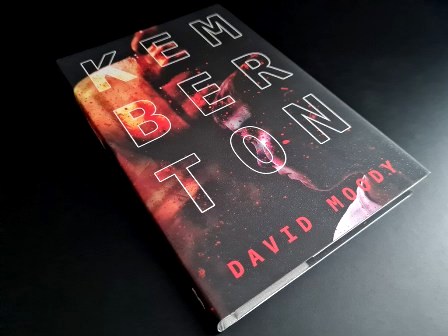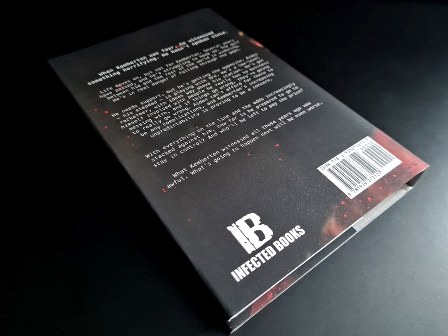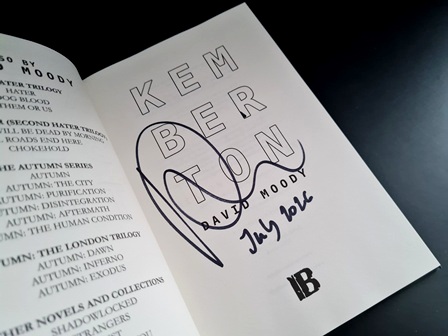
First published back in July of 2026, British author David Moody’s novel ‘Kemberton’ was originally serialised via the author’s website, before being released in this final, fully edited version.
The novel was released in hardback, paperback, ebook and audiobook. The hardback version contains an bonus 11-page essay by Moody on the writing of the novel.
DLS Synopsis:
Most people saw Eddie Phelps as a complete no hoper. He couldn’t find a job and didn’t bother to pluck up the motivation to even try. Although his partner, Sarah, didn’t really care. She loved Eddie for who he was. Besides, somehow, they always got by. The two of them and their four-year-old son, Kemberton. Although it was a meagre life, but it was theirs, nonetheless. A poor family, living above a charity shop, in the rundown suburb of Weoley Castle.
However, Eddie had gotten mixed up with some trouble. Put his family before his dodgy promises and now he was facing some problems. Problems which had finally caught up with him.
Four-year-old Kemberton saw it all happen from the overlooking balcony of their home. At that young age, he didn’t really understand what was happening. His youthful mind couldn’t quite grasp the enormity of what he was witnessing, as his father bled to death on the road below. Stabbed in the chest and left to die in the pouring rain. A terrible act that would leave its imprint upon young Kemerton’s life forever.
Five years later and life has changed significantly for Sarah and Kemberton. It was all down to Sarah meeting Aiden Carter. He’d garnered quite a reputation in property development. So much so, that he could afford some of the finer things in life. A big house in a good area. A comfortable (if not luxurious) way of living. But Aidan, ever ambitious, wanted more. Something that the wealthy criminal kingpin, Declan Priest, presented to him.
All Aidan had to do was ensure he obtained the planning permission Declan needed for his next venture. A development to build a mix of housing and retail upon prime brownfield land. It was a controversial proposal that would no doubt attract a huge amount of attention and challenge. But if Aidan pulled it off for the criminal boss, it could change his and Sarah’s lives. He just needed to pull a few strings and lean on a few councillors, and the deal would be done. Then he’d reap the rewards. Or so Aidan in his naivety thought. However, life was never that easy. Especially when Kemberton was involved.
Since witnessing his father’s brutal murder, Kemberton had retreated into himself. He’d become cripplingly withdrawn, to the point where he’d been diagnosed with Situational Mutism. An anxiety disorder, triggered by his childhood trauma which now manifested itself whenever he was in public. Even at home, he’d barely speak. The one person he’d mutter the meekest of words to was his mother.
What Kemberton needed was love, care and attention. Without that, without the support, perseverance and special care his condition needed, he would continue to withdraw into himself.
Unfortunately, Kemberton’s wellbeing was the last thing on Aidan Carter’s mind. Furthermore, feeling like she had no other choice but to fall in line with her partner, Sarah allowed things to get worse. For her son’s health to deteriorate.
It was a recipe for disaster. One with a young boy trapped within it. A boy who just wants out. A boy who desperately wants to speak, to get better, to live his own life. But no one could hear his silent screams and his wordless pleas…
DLS Review:
Described as ‘Pet Sematary’ (1983) meets ‘Gangs of London’ (2020), I’d personally be more inclined to say it was perhaps closer to James Plumb’s novella ‘Little Monster’ (2016) crossed with Lionel Shriver’s ‘We Need To Talk About Kevin’ (2003). Although, that said, drawing a comparison between young Kemberton and the character of Kevin Khatchadourian really is doing the poor trapped soul of Kemmie a horrible disservice.
Honestly, I’d not heard of Situational Mutism before reading this. It’s a difficult disorder to fully comprehend just through description alone. You no doubt need to live in the presence of one who’s suffering from the disorder to really appreciate its nuances. The struggles and challenges it presents. However, through Moody’s novel, one which we learn was written from the author’s own personal experience of the disorder (through his own daughter), we get to see and feel at least some part of the complexities and challenges attached to it.
To say the novel pulls on your heartstrings is an understatement which feels equally as understated as a calling Situational Mutism a difficult condition. The tale – young Kemberton’s story – is encased in countless layers of psychological tribulation. Tackling the social, mental and psychological constraints which accompany such a disorder. The novel takes you on an inward journey that exposes the reader to so many emotionally charged experiences – you feel more than invested, you feel a part of this inner conflict. An internal and external battle of wills.
Although it’s not entirely written from the Kemberton’s own first person-perspective, we are nevertheless provided with a window into the young boy’s world. It’s a challenging and deeply emotive one, where out heart naturally goes out to the boy. He’s scared if he asks how he can make things better. He’ll be told something about how all he’s got to do is start talking, but that’ll just make him feel even worse about everything again. It’ll just push his words deeper down. Talking is the one thing he wants to do more than anything else in the world, but it’s the absolute hardest thing of all. This crippling anxiety consumes him. It governs his every need, every action, every inaction, almost his every breath. A Catch-22 that makes you feel utterly helpless. Hopeless. Trapped in an endless cycle.
Then we have Aidan. Fucking Aidan Carter. An arrogant, self-important wankshaft who deep down only really cares about his own existence. To him, Kemberton is nothing but an embarrassment. An inconvenience he’d rather just sweep under the carpet. It’s enough to have you gritting your teeth in anger. Your blood boiling as you read between the lines, see the fakery of his surface-level words and promises, his offhanded dismissal and arrogance at thinking he knows what’s in all their best interest.
The complexity of this family situation is perhaps best observed through Sarah. Her conflict of feeling trapped and reliant on Aidan and his wealth. But it doesn’t take much to see behind this. How she avoids taking any responsibility. Siding with the easy option rather than the love and care Kemberton actually needs.
However, it doesn’t end there. From this broken and false bedrock of a dysfunctional family, Moody plunges us off the cliff edge and into an abyss of absolute gritty, dark horror. Honestly, what comes to us in the latter third of the novel is pure, unadulterated horror in its absolute essence. Horrifying and horrific. Gut-wrenching and terrifying. A boy who through an absence of love and the care he needs, plummets into a maelstrom of grisly violence and death.
The depth of this horrific descent will have you transfixed. The horror unleashed after the world has failed this tormented young boy is terrifying. But it’s the human element behind it all, the lost voice, the boy’s confusion and desperation that Moody retains to the very last page, which will haunt you afterwards. It’s painfully sad. A tragedy set to slice away at your raw and exposed nerve endings.
It’s an emotionally charged, gut-wrenchingly evocative, bleak but still utterly human tragedy. An exaggerated, fictious window on real life? Yes, but one that’s rooted in the complex psychological latticework of being human, nonetheless. Failure on so many levels that comes to roost in such a terrifyingly brutal way. Carving a long-lasting memory in your mind of what it was to know Kemberton.
The novel runs for a total of 274 pages.
Say Something – 11 Pages
[Hardback Edition – Bonus Material]
Say Something – 11 Pages
[Hardback Edition – Bonus Material]
The hardback edition also includes an 11-page essay by Moody about the writing of the novel. In this incredibly insightful piece, Moody wears his heart on his sleeve, telling us about his family and in particular his daughter – Zoe – and her own struggles with Situational Mutism. We also find out about the journey Moody went through with writing the novel, the change in direction he took for the dysfunctional family unit within it, and the decision to first serialise the novel. It’s an excellent concluding piece which makes the story that much more powerful, and honestly, makes you love Moody as a writer and a person that much more.

© DLS Reviews