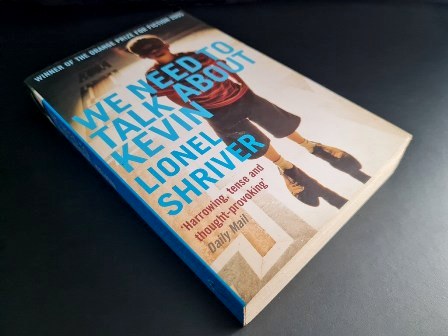
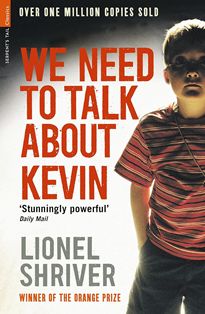
First published back in April of 2003, US author Lionel Shriver’s novel ‘We Need To Talk About Kevin’ is probably the author’s most notable offering, winning the 2005 Orange Prize for Fiction as well as being widely revered by numerous critics as a powerful and compelling, yet a deeply disturbing read.
The novel was later adapted into the BBC Film of the same name, which was released in 2011, as well as well as a BBC radio adaptation that was broadcast in 2008.
On Thursday the 8th April 1999, fifteen-year-old high school pupil Kevin Khatchadourian murdered seven fellow students, a teacher and a cafeteria worker at Gladstone High School. The massacre sent shockwaves through the local community and obtained national coverage across the media. What perhaps shocked the American public the most, was the apparent lack of any warning signs, the absence of any clear motive, and the teenaged boy’s relative nonchalance to what the atrocities he committed.
Almost everyone missed the escalating threat Kevin posed. Outwardly, throughout his young life, Kevin Khatchadourian had been relatively nondescript. His upbringing was from a wealthy American suburban family unit. His Armenian mother – Eva Khatchadourian – had formed a successful travel agency and travel guide author. The ‘Wing and a Prayer’ guides were an institution in themselves. Eva had spent her life creating the business, and as CEO, the family could now afford a comfortable lifestyle in the suburbs of New York.
Furthermore, from the moment Kevin was born, his father – Franklin Plaskett – doted on the boy. He could do no wrong in the eyes of Franklin. Whatever occurred, perhaps an accident or other such event or problem, Franklin never saw Kevin as truly responsible. Sometimes life just kicks up troubles. And of course, boys will be boys.
Nevertheless, there was something off about Kevin. Eva was aware of it from the moment Kevin was born. She saw it in every aspect of the boy’s nature. How he always looked at everything from the perspective of what he didn’t like, rather than what he did like. An absence of any passion of love for anything. Kevin was a shell game in which all three cups were empty.
Eva couldn’t help but feel that from an early age Kevin had set about to oppose her. As if he was constantly almost at war with everything she did. He wore nappies until he was six years old, refusing to adopt any toilet training and making Eva clean and change him each day. He’d pretend ignorance and feign stupidity, only to learn speech, writing and counting quietly away from prying eyes. Denying Eva of the parental reward for such teaching.
It was a pattern which Eva observed all through Kevin Khatchadourian’s young life. To always be at odds with her. To crush her spirit, to take away any satisfaction from parenting, to sap all joy that could have been attainable from raising a son.
To Eva, Kevin Khatchadourian was not like other boys. She saw him as devoid of any purpose, cold, callous and calculated in his oppressive existence. She saw it all. She saw the boy for what he truly was. She tried and tried and tried to have the family that Franklin always wanted. That her husband believed they could have. That he kidded himself they actually had. But with Kevin, it just wasn’t there.
Eva knew all along, there was something truly worrying about Kevin…
As I alluded to at the start of this review, Shriver’s ‘We Need To Talk About Kevin’ is a difficult read with many deeply disturbing elements. One of the main ones is the cold reality of such a story. School massacres happen. Hell, the story mentions a vast number of these real-life school shootings throughout its length. As such, this challenging subject matter draws distinct parallels to the likes of Stephen King’s now purposefully out-of-print novel ‘Rage’ (1977). A subject that feels too close to the bone due to the reality of such horror within our modern-day lives.
However, perhaps the most disturbing of all, more so than the link to real life, is the complete nihilism exhibited in the novel – or should I say – exhibited in the character of Kevin Khatchadourian. Essentially, we follow Kevin’s life from the moment he’s born, all through the years to his killing spree when he’s just fifteen, as well as for a couple of years afterwards. Through this watchful window into the upbringing of the boy, we gradually piece together a jigsaw of Kevin, which is taken from the perspective of his mother. And it’s a deeply unnerving picture. One of an absence of any joy despite the love, care and attention the boy is given. An almost rejection of life and the richness that it can offer. How everything breath the boy takes, everything he does, is purely to sap the enjoyment out of everything.
The story is written by way of an epistolary, in which it’s told entirely through the medium of letters that Eva Khatchadourian has written to her husband, between November 2000 and April 2001 (i.e. after the tragic school massacre). The letters are all one-sided (i.e. all from Eva) and as such, we only have that one perspective. However, Eva’s letters are lengthy, in-depth and written in a storytelling way, with dialogue within many of the letter to explain to her husband what life with Kevin was really like. The story of his upbringing.
The big event of the story – the school massacre – is mentioned at many junctures throughout the tale, however, the full story of that terrible day is only covered at the very end of the book. Beforehand, we have the foundations, an escalating build up towards what we know will eventually culminate in horrific tragedy.
Injected within this adolescent’s story we have so many carefully crafted intricacies, which Shriver has carefully considered and scattered throughout the book. Those small things, which collectively come together to form a picture in your mind. How Kevin insists on wearing clothes which are grotesquely too small for him, his empty room but for a copy of ‘The Merry Adventures of Robin Hood’ and later how he collects computer viruses on floppy discs – seemingly one of his only hobbies which brings him any satisfaction.
Of course, the terrible grand finale is powerfully written and deeply unsettling. In fact, there’s more in that fateful day than is alluded to in all those pages running up to the traumatic event. Twists which hit like a sledgehammer to your gut, which even now, as I write this review, still make you feel empty and deeply saddened.
The writing, the prose, the descriptions and carefully inserted dialogue are incredibly well-crafted. Shriver is a master storyteller. One who paints such a vivid picture and establishes such a complexly layered mood throughout the book. It unsettles your nerves, plays on your emotions, lets your mind explore the unwritten elements, and then for you to take your own thoughts upon the evolving story and its consequences.
Shriver also doesn’t provide the answers but instead allows the storyteller – Eva Khatchadourian – to merely ask the questions. To leave things open to her husband (but really the reader) to draw whatever conclusions you can. To inject your own thoughts and feelings. To maybe question parenting, society, culture, and indeed that whole nature versus nurture debate.
It’s certainly not a light read, but instead one that truly haunts you. You’ll find that you’re often left thinking about Kevin, about Eva and the other characters for some time after putting the book down. However, the nihilism within the entire piece is where the hardest blow hits you the hardest. It’s difficult to comprehend such an existence. Such a want for such emptiness. To only thrive in unending negativity. To exist solely for the wanton lack of passion and love.
The novel runs for a total of 468 pages.

© DLS Reviews