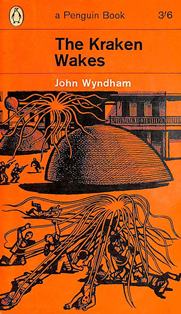
First published back in July of 1953, British author John Wyndham’s novel ‘The Kraken Wakes’ followed on from the author’s highly successful sci-fi horror ‘The Day Of The Triffids’ (1951).
An abridged version of the novel was published in the US under the alternative title ‘Out Of The Deeps’, which cut out almost an entire chapter from the latter section of the book. Since the novel’s release it has been reprinted in numerous editions as well as a handful of dramatic radio adaptations.
DLS Synopsis:
Mike and Phyllis Watson had been on their honeymoon aboard the luxury ship ‘Guinevere’ when they witnessed the first of the curious phenomenon. The newlyweds, together with over a hundred of the passengers and crew, watched as five pinkish-red objects came crashing down from the night sky above into the ocean.
Days later reports of similar sightings started to arrive. However, despite the increasing number of sightings, not a single observer had observed one of the fireballs descend onto land, and not a single one of those descending on water had been observed from the shore. In fact, all had been seen far out at sea.
No one had any idea what the strange fireballs were, nor why they were all targeted for the deep sea. Because of his firsthand sighting of the fireballs, alongside his position as a journalist with the EBC in which he’d been collating together whatever accounts and reports he could get, Mike Watson was quickly drafted in to assist the government with their own investigation.
Together with the esteemed Professor Alastair Bocker, they began plotting the locations of the fireball sightings. It soon appears there are five main areas of concentration. The densest being the southwest of Cuba, along with six-hundred miles south of the Cocos Islands. Heavy concentrations are also reported off the Philippines, Japan and the Aleutians. All without exception are deep-water areas.
A two-maned Bathyscope is sent down into the depths of the Cayman Trench to investigate what is happening. Live footage obtained by the two naval men reveals something lurking down in the murky depths. However, before the two men can get a clear view of what it is, the cables to the underwater vessel are severed. When the ship above winds the cables for the depth-chamber back to surface level, all that remains are the ends of the heavy cable, severed in a blob of fused metal.
Before long further ships have been attacked by whatever it is lurking in the depths. First a naval ship is electrocuted, instantly killing the crew and disabling the ship. Then the Yatsushiro – a Japanese luxury liner full of seven-hundred men, women and children, all peacefully asleep, is wiped out in a few seconds in the middle of the night.
It’s not long before the deep seas are off limits. There’s clearly something terrifying lurking in the deep waters. Eyes move to Russia, but the despite the rising tensions, the feeling remains that the threat is something different. Something out of this world. Something beyond our collective capability.
Then they emerge. The otherworldly beasts of the sea. They are real and they have an agenda. The extinction of mankind is the top of their plan…
DLS Review:
Let’s be honest, how the hell do you follow a masterpiece like ‘The Day Of The Triffids’ (1951)? I guess that’s never going to be an easy task. What we have with ‘The Kraken Wakes’ is a novel of a similar vibe insomuch as it’s still within the arena of an apocalyptic sci-fi horror. However, the narrative is markedly different. It takes a much wider, higher-level view of the threat and its environment, social and economic impact.
I guess what I’m saying is Wyndham’s taken a notable step back from the coalface of the action and the immediacy of the threat. Essentially a sort of wider scope, almost voyeuristic in how we watch from a position of oversight, as the world is forced to adjust to its seas suddenly becoming a no-go-zone and assault on seacraft and coastal inhabitants happening sporadically.
Indeed, where ‘The Day Of The Triffids’ (1951) took us face-to-face with the unfurling threat, for the vast proportion of this novel we generally only see the aftereffects of the attacks. We see how the world is forced to adapt and change and hear through reports of the escalating maritime disasters. We see the aftermath and the mayhem wreaked, but not much more than that for the most part – other than one distinctly adrenaline-pumping chapter that is.
What does this mean for the novel? Well, I’ll be honest, it’s perhaps less engaging for the reader in general. We’re not at the forefront but rather just following the events almost as if we’re watching daily news broadcasts.
Only when we get to page 138 of the 240-page novel are we delivered our first proverbial glimpse of the sea beasts. Described as ‘sea-tanks’ we find out they’re akin to huge metallic slugs shuffling across the land. They also have strange bubbles rising out of them which fire weird sticking cilia out of them, which they use to ensnare their victims and drag them back to the beasts to be consumed.
It’s during these sections of the novel where it perhaps draws the strongest parallels to H.G. Well’s ‘The War Of The Worlds’ (1898). Vast alien creatures, who’ve come to our planet seemingly to harvest mankind and make the planet their own.
This full-frontal coastal assault isn’t the end of it though. In the third phase of the book, we have another shift in the narrative. By now mankind has pretty much adjusted to the threat (albeit mankind’s population has drastically reduced). People have moved inland and set up sentries and defences. But the aliens have other plans. And so things shift with the attack, and like with ‘The Day Of The Triffids’ (1951), we find that the apocalyptic disaster has layers. A sort of two-stage assault which changes the dynamic of the novel further still.
The end result is a tale that’s interesting, intriguing and genuinely compelling, but doesn’t necessarily grip you with an adrenaline-pumping narrative like the author’s previous masterpiece. It’s certainly not a comfy, quiet apocalypse, but nevertheless its punch feels slightly lacking in gusto and delivery.
I was expecting and indeed hoping for a tad more from the tale. That’s not to say I was disappointed, but I can nevertheless see why it’s not referenced or revered anywhere near as much as its predecessor. It’s still worth a read though.
The novel runs for a total of 240 pages.

© DLS Reviews