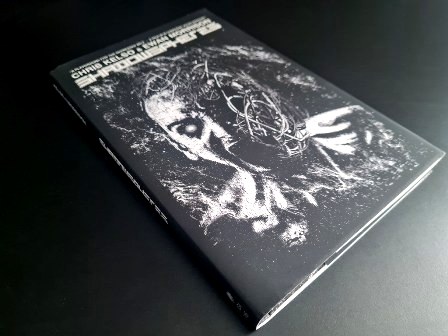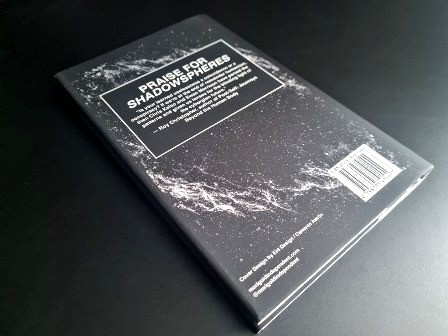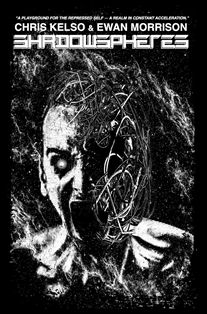
First published back in February of 2026, Scottish writer’s Chris Kelso and Ewan Morrison’s ‘Shadowspheres’ offered up a blend of dystopian nonfiction, speculative fiction and philosophical reflection, examining what remains human when society fractures.
The essays and short stories contained within the book explore the psychological and cultural fallout of a world accelerating into a loss of humanity, largely through the escalating rise in the acceptance and unguarded administration of Artificial Intelligence.
DLS Synopsis:
The accelerating use of Artificial Intelligence (‘AI’) is a topic which it would be fair to say is at the forefront of our cultural and societal world. We’re beginning to see AI relentlessly culling jobs via a new stage of techno-capitalism. All of this under the short-sighted goal of human replacement.
Such a willing infiltration of AI into our personal world, into our lives and existence, is perhaps none more apparent than with Ellie. Here we have a young woman, lost in a world that seems to have left her by the wayside. She feels lost, alone, but the human mind is inquisitive.
Ellie decides she needs to know more of her own life. Her own fate. So, she asks her AI companion – Nate – what her future is likely to look like? Essentially, if she gives Nate access to all her personal files – her medical records, employment history, banking data, government ID, travel history, family history and insurance records – access to absolutely everything, could Nate draw a map of who she is? Could AI work out what’s going to happen to her in the future, according to its algorithms and the calculated analysis of probability? For Ellie, it’s worth a shot.
The infiltration of AI in our lives, in almost every aspect we can envisage, sparks increasingly worrying consequences. It threatens to render your everyday employee as useless. Replacing jobs with an unparalleled merciless efficiency. Separating those who remain useful, from those who have become useless. Suddenly labelled a drain on resources. Those who contribute versus those who do not.
Eventually the situation will give rise to a technofascism, powered by the machine-logic of AI-calculated utilitarianism. The summation of all your life abilities, calculated within the algorithms as either productive or unproductive, from the outlook of the survival and growth of the techno-state.
Hierarchy and cultural stigma become exaggerated. The divide between the contributors and the bottom feeders, increasingly pronounced. In the financially deprived Uz high-rise located in the heart of Belgrade, such a broken wheel of existence is exhibited on a daily basis.
There we see officers Dryer and Patton attempting to catch up with a small-time dealer named Leonard. A seemingly standard day on the force, which through a sudden twist of fate, brings to the surface an inbuilt prejudice that’s hard to shake. Even in the world of women’s boxing, we see a broken, fractured split in what it is to be human. The struggle to find worth in oneself. The loss of care for others. The complete loss empathy.
We also witness the experimental use of nanobot gene optimisers, infiltrating our flesh and blood. Microscopic robots injected into rogue tissue to regenerate necrotised tissue. The blend of science and technology. Man and machine.
And ahead of all this – perhaps somewhere in the not-too-distant future – the Guardians of Last Things. A family travelling around the smouldering planet in their spaceship made of junk, saving the last things that could never be replaced, when everything is disappearing forever.
They’re all stories, but stories with a close association to our unfolding reality. A precipice we’re teetering over. The abys before us – the loss of humanity, the loss of empathy, the tragic and final loss of ourselves…
So, what happens when two Scottish writers of the calibre of Kelso and Morrison come together to write about the dystopian rise of AI? Well, a bleak fucking read for one! We’re not talking a high-brow reworking of the ‘Terminator’ films here. Instead, we’ve got a considered, well researched and carefully hypothesised projection of a not too far away future.
Okay, so both writers work in the creative sector, which is an arena that’s perhaps under the greatest threat from the infiltration of AI. As such, as expected, their perspective on AI is heavily weighted upon a dystopian outlook, rather than a particularly utopian one. Not that the author’s don’t at least highlight the views of those who try to take a more positive light on the topic. They make reference to numerous social commentaries and philosophical essays, conversations both for and against the rise in AI. However, it’s the latter, which takes the sway of the book’s direction.
The construction of their offering is built via a series of thought-provoking essays written in a conversational tone, interspersed with fictional stories delivering a parallel running human element to this dystopian outlook. The first of these stories is a poignant dialogue between a young woman named Ellie (who suffers from a Borderline Personality Disorder) and an AI chatbot named Nate. This conversation, although laced from head-to-toe in a satirical tone, is nevertheless a bleak example of how far we’ve come (or how far we’ve fallen depending on your perspective). It shows the surrendering of one’s entire life and existence to the algorithms of a machine to then predict the course of this woman’s future. It’s insane, but let’s be honest, probably entirely feasible right now!
Of course, the further we immerse ourselves in the authors’ vision, their jointly shouted warnings, the more we see how probable and dangerous to society this whole AI setup is. There’s undoubtedly been a corrosive complacency to our gradual acceptance of AI taking over our lives, our livelihoods, possibly our very beings. Its presence rises to the surface all around us within a sort of techno quagmire. And all the time we have this casting aside of individual worth, which resonates throughout the authors discussion.
The use of particular language within the book, most notably a sort of satirical pseudo-technological mumbo jumbo, stirs the pot further. We see the authors inserting the word ‘techno’ before almost every action, idea or cultural consideration, to almost tarnish everything with a corruptive stigma. Implying a sort of surrender to this technological infiltration. Almost crying out it’s everywhere! It’s alive…it lives!
Later we see stories of human endeavours – a police visit to a small-time dealer which sparks thoughts of a subconscious prejudice – emphasising the cultural divide gradually being carved deeper and deeper into our society. Then we have a female boxer, who’s drive towards personal success sees her compassion, empathy and dare I say humanity, dissolving with each breath she takes. It forms a stark parallel to the downgrading of our human ties. This butchering of our collective empathy for each other.
In a similar vein to Aldous Huxley’s ‘Brave New World’ (1932), George Orwell’s ‘Nineteen Eighty-Four’ (1949) or indeed Eugene Zamiatin’s ‘We’ (1924), the book screams a dystopian warning – that we’re leaning over the precipice into a techno-abyss (jeez I’m doing it now), on a similar level to the Climate Change threat.
The end result, as I said before, is bleak and deeply concerning – almost to the degree of an end of times. But it’s real. Fucking real and fucking everywhere! You can’t escape from the infiltration. The problem is, no voices seem strong enough to quell the tide of this (supposed) techno-progress. We see people and corporate entities banding about phrases like “responsible use of AI”, but what really is it to be truly responsible within such a highly invasive yet subtle surrendering of our collective abilities and overall worth? The questions mount up like corpses in a mass grave, to be buried without ever bothering to expose the identity of the fallen.
I could wax lyrical for hours about where these two writers have taken my own personal ponderings on the subject. How they’ve set alight the already smoking kindling of my mounting aversion to AI. Am I just a middle-aged technophobe which this book resonates with? Granted, there might be some of that at play here! But then we can’t hide from the facts starkly laid out on the table for us by these two writers.
Okay, so I stand by the flesh-and-blood rebellion Kelso and Morrison are nudging us to step out of the crowds and commit to. Not just to accept and hope for the best, but to care for what we could be unwittingly surrendering to. Stand shoulder-to-shoulder with those at the frontline as they peer over the edge and into the abyss, with courage of our convictions about the absolute importance of the matter.
It’s a powerful piece. Thought-provoking and passionate. And maybe sometime in the not-too-distant future, the book will be seen as more than a fantastical predication, but instead a very real warning which we should have done more about than just listen to.
Fuck AI.
The book runs for a total of 140 pages.

© DLS Reviews