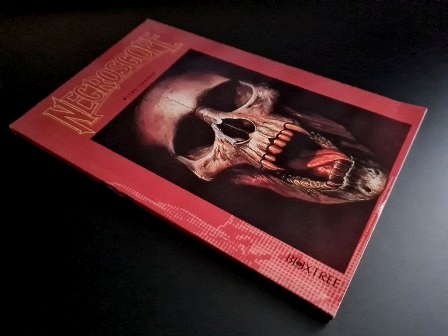
First published within a single volume back in June of 1994, the ‘Necroscope’ graphic novel collected together the original five comic books which formed the adaptation of Brian Lumley’s highly revered novel ‘Necroscope’ (1986).
The graphic novel was adapted by Martin Powell with artwork by US illustrator Dærick Gröss (aka Richard Gröss).
DLS Synopsis:
Whilst the US and other such countries comprising the world’s powerhouses regarded extrasensory perception (‘ESP’) as somewhat of a ‘neat area’ for a small amount of exploration, the Russian’s had astutely recognised the potential of such abilities, and as such, had put far more resource into its exploration and exploitation. Ex-Army General Gregor Borowitz, the Head of the Russioan’s ESP-Branch, lead these highly secretive explorations.
Borowitz had a number of ESPers within his command, whose collective abilities ranged immensely. Borowitz recognised the most skilled of these individuals to be Boris Dragosani. This strange, arrogantly and unquestionably difficult man had become the necromancer to the Kremlin. A deeply ambitious individual who was able to steal secrets from the blood and guts of the dead. Secrets which the Kremlin used to their advantage.
However, whilst Dragosani may appear to be loyal to the USSR and indeed Borowitz’s ESP-Branch, the necromancer had his own ambitions which reached far beyond his current position. The Romanian had started returning to his homeland, seeking out a particular out-of-the-way spot within the cruciform hills. A spot where he had first acquired his abilities as a necromancer. A shadowy area, hidden by a canopy of trees, in which something ancient lay in the earth. An old thing which spoke with him, promising the secrets of the Wamphyri. An age-old knowledge which would make Dragosani powerful beyond his dreams.
But Russia weren’t the only ones to appreciate the potential of ESP. The British had been making large strides within the highly secretive field. When the Russian’s learn of this, the Kremlin know they cannot just sit and watch the British advance further in such an area. They have to act, or they will be overtaken. Something which Borowitz simply can’t allow.
However, Britian has a young prodigy who’s beginning to show abilities beyond anything seen before. Harry Keogh has found he’s able to speak with the dead. The boy is a necroscope. Unlike the abilities of a necromancer, who forces the secrets out from the dead, Keogh instead is able to speak with them, learn from them, and through doing so, acquire their otherwise lost knowledge.
A battle of powerful necromancy is about to play out. However, Dragosani’s drive for power has led to him drawing upon something far darker. History has hidden mankind’s ancient enemy. The threat of the near-immortal undead has been almost forgotten. Vampires are no longer feared. The passing of time has seen the Wamphyri cast into folklore and ancient hearsay.
But the Wamphyri are real. In the Romanian hills, such a restless beast longs for its time to return to renewed undeath. To walk the earth again. Through Dragosani this ancient Wamphyri seeks a way for its return. Although it cannot be trusted, Dragosani’s drive for power is strong. Maybe strong enough to eventually unleash the old thing he has spent so much of his life conversing with. The thing that known as the devil, the bat, and the dragon…
Brian Lumley’s ‘Necroscope’ (1986) is quite frankly, an incredible novel. Hugely ambitious, involving so many intricate parts and interweaving layers. Epic in the magnitude of its conceptual design and the creation of such an intricate lore. So how will an adaption into the format of a graphic novel fare?
Well, for a start, pretty much every aspect of the novel has needed to be condensed down quite dramatically. This hasn’t necessarily meant losing large chunks or parts of the novel, but rather massively reducing them down to almost their bare bones.
Scenes like when the tale depicts the history of Faethor Ferenczy, when during a WWII bombing raid he’s pinned down, impaled and then killed. The entire history that precedes this scene, explaining who Faethor Ferenczy is, his power, how he’s lived for countless centuries, leading to his eventual isolation within the old house – the original book goes to great lengths to plot this all out. This helps to cement the history of the Wamphyri for the reader.
However, in the graphic novel this whole piece about Faethor Ferenczy, his power and influence, and how Ladislau Giresci ended up putting the beast out of its misery, is literally covered over just three pages. There’s none of the backstory about Ferenczy’s long, long life. None of consequences of living generation after generation, having to isolate himself with only one faithful servant. The graphic novel had to be condense everything down, and as such, we only witness the end sequence of this whole piece of the jigsaw. We see Ferenczy impaled, and in agony and then Giresci killing him, which leads to Giresci witnessing Ferenczy’s final transformation from human form to a demonic-looking Wamphyri.
However, for the main part, the graphic novel (although abbreviated) remains true to the original tale. It covers all of the key scenes, retelling the story in its original state. Even the bookending conversations between Harry Keogh Jr and Alec Kyle, including all those brief times we jump back to their conversation during the novel, are included within the adaptation.
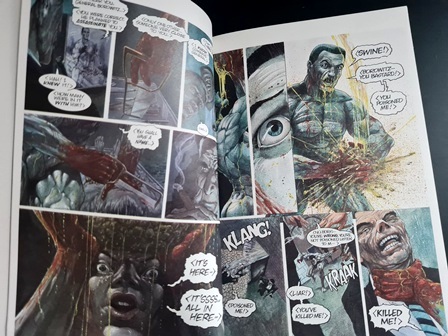
What’s great to see is that the graphic novel has also managed to really capture the essence of Boris Dragosani. We see the necromancer as horrific and brutal as he was in the novel. Indeed, at the very beginning, we see graphic depictions of his necro rape, with him ripping and clawing at the dead Russian operative’s flesh, before cutting out the brain to draw out the secrets from within.
What I would say though, is although I thoroughly enjoyed reliving the original novel through this illustrated retelling, I’m not sure if the graphic novel would work so well for someone who’s not already familiar with the original novel. The condensing down of the tale was undoubtedly a necessary evil. However, without having the full context, the detailed backstories, and the various threads that subtly intertwine, instead relying solely on the core pieces within the tale, there’s a likelihood that much will be missed, or the relevance not fully appreciated.
So many times, whilst reading the graphic novel, my mind was sent back to the original tale, my memory slotting in the missing pieces and thereby understanding the context and relevance of each part. I’m not convinced this would be achieved if someone was to read the graphic novel in isolation. There seems to be too much that’s taken for granted. Too much that we’re expected to understand the relevance of. This is fine for anyone who’s read the novel but probably won’t work so well for anyone who’s going into the graphic novel blind.
That said, if you’ve read ‘Necropscope’ (1986), then this graphic novel adaptation is an excellent way to refresh your memory of the story. Personally, I’m about to embark upon the second book in the series – ‘Necroscope II: Wamphyri!’ (1988). However, it’s been a good year since I read the first book. As such, reading the graphic novel beforehand has provided a perfect reminder of the key aspects from the first book, setting me up perfectly for the next leg in this spectacular story.
The graphic novel runs for a total of 120 pages.

© DLS Reviews